BUDGET: Between 5 crore INR and 9.99 crore INR (More than USD672,000 but less than USD1.35 million)
Project Overview
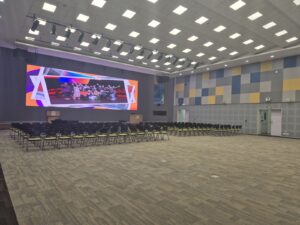
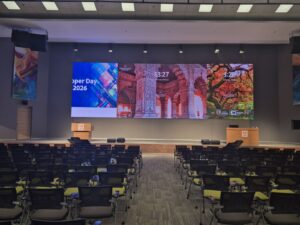
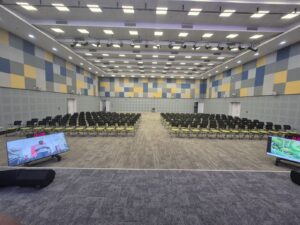
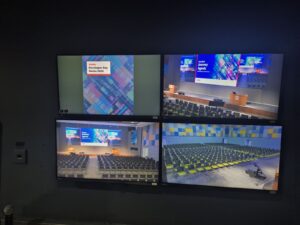
Adobe engaged SI to deliver the third major upgrade of the Rangmanch Auditorium at its Noida campus. First installed with a single projector in 2012 and upgraded to dual projection in 2019, the space was transformed again in 2025 with a 13.2 m x 4.05 m direct-view LED wall.
Rangmanch is a multipurpose venue used as a badminton court with flexible seating, as well as for global town halls, presentations, live singing and orchestra performances. A multi-window processor creates a virtual canvas that changes layout by event, allowing several sources to appear simultaneously across the ultra-wide screen.
Five 4K PTZ cameras support presenter and audience capture, while production switching, recording, streaming and Cisco collaboration enable live and remote participation.
SI also upgraded the audio with column-array loudspeakers, subwoofers, wireless microphones and digital signal processing. Crestron control unifies video, cameras, audio and DALI-based zoned lighting through touch panels, browser interfaces, the lectern and master control room.
The result is a flexible auditorium that can shift from sport to presentation, performance or broadcast use through coordinated technology.
What did the client want to achieve?
Adobe wanted Rangmanch to support far more uses than its previous dual-projection system could accommodate.
The auditorium shifts between a badminton court with flexible seating, leadership presentations, global town halls, live singing and orchestra performances. Adobe needed one visual platform that could adapt to each format, show several sources at once and remain clear across the wide venue.
The client also required stronger production capability. Presenters, performers and audience members had to be captured for recording, streaming and remote participation. Global events needed dependable video conferencing and flexible content layouts without rebuilding the system for every programme.
Audio had to support speech, music and performance, while zoned lighting needed to suit different event modes.
Above all, Adobe wanted complex production technology to remain manageable. Operators needed coordinated control from the lectern and master control room, with touch-panel and browser access for authorised users. The objective was one flexible environment that could change purpose quickly while delivering a consistent experience for local and remote audiences.
Scope of work your company was involved in
SI designed, supplied, integrated, programmed and commissioned the 2025 Rangmanch Auditorium upgrade.
The dual-projection system was replaced with a 13.2 m x 4.05 m Unilumin direct-view LED wall. An Analog Way multi-window processor creates a virtual canvas across the ultra-wide display, allowing layouts to change for town halls, presentations, performances and other event modes. Lightware AV-over-IP distributes 4K content between sources, processors, displays and production systems over fibre.
Five Panasonic 4K PTZ cameras provide presenter, stage and audience coverage. Blackmagic recording and production switching support live production and streaming, while Cisco Codec Pro enables global town halls and hybrid participation.
The audio system combines Bose column-array loudspeakers, subwoofers and networked amplification with Biamp processing and Shure wireless microphones. Dante supports flexible digital audio routing.
Crestron control unifies the touch panel, browser interface, lectern and master control room. DALI-based zoned lighting adapts the space for different activities. Actis also completed programming, interface development, testing and commissioning.
What key challenges were faced?
The greatest challenge was transforming a large multipurpose auditorium into a presentation, performance and broadcast environment without restricting its everyday use as a badminton court.
A conventional display could not serve every application. Town halls need a clear central image, presentations may require supporting content and live events can benefit from several simultaneous feeds. The 32:9 LED wall therefore had to function as more than one large screen.
Camera coverage was also complex. Presenters, performers and audience interaction had to be captured across a wide space for global events, recording and streaming, requiring several camera positions and coordinated production control.
Audio had to support speech, live singing and orchestra performances, each placing different demands on microphones, loudspeakers, subwoofers, processing and mixing.
As the third major technology generation in the auditorium, the project also required Actis to move beyond the earlier projection system and integrate a new LED, AV-over-IP, production, audio and control ecosystem.
Operators then needed to manage video layouts, cameras, audio and zoned lighting from several control points without unnecessary complexity.
How were those challenges resolved?
SI treated the auditorium as a configurable production environment rather than designing it for one fixed use.
The 13.2 m x 4.05 m LED wall operates as a virtual canvas through an Analog Way multi-window processor. Operators can change the number, size and position of content windows for town halls, presentations and performances without altering the display. A fibre-based Lightware AV-over-IP system routes 4K sources where required.
Five Panasonic PTZ cameras cover the stage, presenter and audience. A Blackmagic production switcher selects camera and content feeds for local display, recording and streaming, while Cisco collaboration connects the auditorium to global participants.
For audio, Actis combined Bose column arrays and subwoofers with Shure wireless microphones, Biamp processing and Dante-enabled routing. This supports speech, music and live performance across different event formats.
Crestron control unifies video, cameras, audio and DALI-based lighting zones through the master control room, touch panels, browser interfaces and lectern. This reduces the actions needed when the space shifts between sport, presentations, performances and global town halls.
How has your work helped the client?
The upgrade has given Adobe one auditorium for sport, corporate communication, performance and broadcast use without fixing the space to a single format.
The ultra-wide LED wall provides a larger and more flexible visual platform than the previous dual-projector system. Its virtual canvas lets operators arrange multiple sources for global town halls, presentations and live events, improving how information, remote participants and camera feeds are shown.
Five PTZ cameras, production switching, recording and streaming systems capture presenters, performers and audience interaction, extending programmes beyond those in the room.
The upgraded audio system supports clear speech, live singing and orchestra performances. Wireless microphones suit different presenters and performers, while digital processing and routing adapt the system to each event.
DALI-based lighting zones and centralised Crestron control help operators change the environment from the lectern, touch panels, browser interfaces and master control room.
Manpreet J Singh of Adobe stated: “I would like to appreciate the excellent support you and the entire SI team have provided to us, not only for this project but also other projects executed in recent years. I am really thankful for this.”
What are you most proud of about the project?
We are most proud of transforming Rangmanch for a third time while preserving the flexibility that makes it valuable to Adobe.
The 2025 upgrade did more than replace two projectors with a larger display. Actis created a 13.2 m x 4.05 m virtual canvas that can be reconfigured for global town halls, presentations, live performances and other events. Multiple sources, camera feeds and remote participants can be arranged to suit each programme.
The project also added professional production capability to a space that still functions as a badminton court with flexible seating. Five PTZ cameras, recording, streaming, video conferencing and multi-window processing capture the presenter, stage and audience without fixing the room around one seating plan.
Audio, lighting and control were designed with the same adaptability. Column-array loudspeakers, subwoofers, wireless microphones, digital processing and DALI lighting zones support speech, music and performance. Crestron control coordinates these systems from the lectern, touch panels, browser interfaces and master control room.
This combination of continuity and reinvention reflects SI’s long-term partnership with Adobe.
VIDEO link of the project space: Not available.